Value Based Care: every missed HCC code is a care gap and a revenue gap.
Value Based Care depends on documenting every chronic condition every year, or those diagnoses drop off the RAF calculation. Althea Smart EHR analyzes ICD codes from current and past claims in real time, surfacing missed HCCs at the point of care so providers can close care gaps and capture the RAF score that reflects true patient complexity.
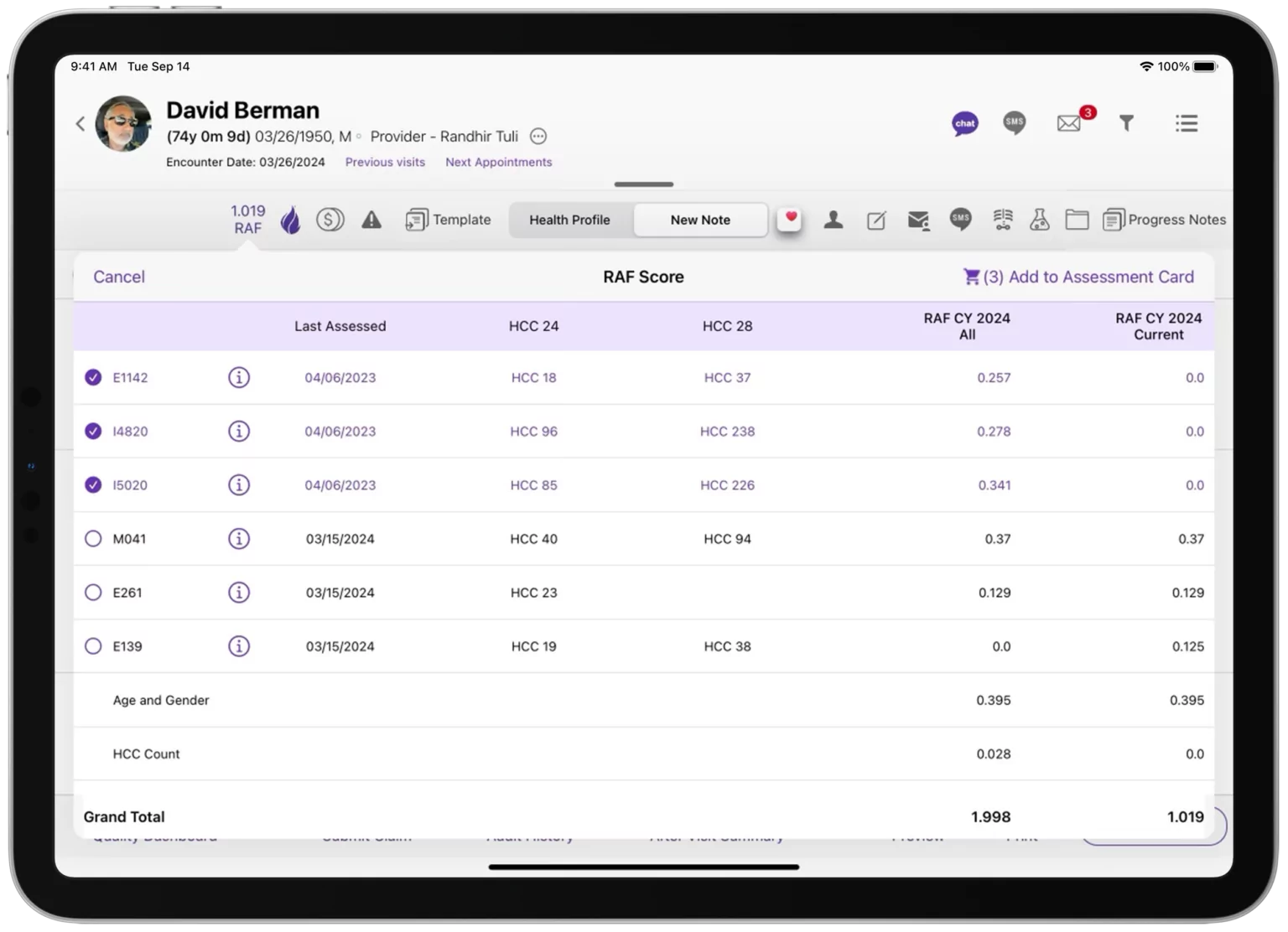


Stop losing revenue without realizing it.
Most primary care practices don’t lose value-based revenue because of clinical gaps. They lose it to documentation and workflow gaps. RAF management is reactive instead of proactive, chronic conditions slip past busy visits, and small omissions compound across the panel. Althea Smart EHR works inside the chart to flip the model: every gap surfaces before the encounter, with the clinical and financial impact in plain view.


Chronic conditions must be re-documented every year, or they fall off the RAF calculation, even when the patient still has the condition. Althea Smart EHR cross-references the active problem list against historical claims and flags every diagnosis that hasn’t been recaptured this year.

Each suspect HCC shows its RAF weight and projected PMPY revenue impact. A small group of high-risk patients (often around 10% of a panel) can drive over a third of total revenue potential. Physicians see exactly which diagnoses move that needle.
Not a bolt-on dashboard. Discovery, categorization, risk-assessment, list-cleaning, and association all run inside the same Althea Smart EHR chart your providers already use, on iPhone, iPad, Mac, or PC.
Five steps. One unified RAF engine.
Find what the chart forgot to say.
- Multi-year claim sweep. Looks back across the full available claims window (not just the current encounter) to catch conditions that drop off without annual recapture.
- EMR + claims reconciliation. Matches what was billed against what’s actively documented. The delta is your gap list.
- Pre-visit ready. Gaps load with the patient chart so they’re addressable during the encounter, not flagged in a retrospective sweep weeks later.
Organize the chaos. By specialty. By system.
- Specialty-aware sorting. Cardiac, metabolic, renal, behavioral, musculoskeletal: grouped automatically.
- Per-provider views. Each clinician sees their specialty's problems first. The rest collapse into a footer.
- HCC-aware grouping. Risk-adjustable diagnoses are tagged so they're never lost in a long list.
Quantify every diagnosis. In the same screen.
- Per-diagnosis RAF weights. Real-time scoring against the active CMS-HCC model, updated as CMS revises weights.
- PMPY revenue projection. See the dollar impact of capturing each gap, per patient and aggregated across the panel.
- Visit-priority cues. Diagnoses worth addressing today, and patients with the highest combined gaps, surface at the top of the schedule.
Lapsed, duplicate, related: flagged on sight.
- Lapsed-flag rules. Acute conditions with no recent activity surface for review, not silently kept active.
- Duplicate detection. Two ICDs for the same condition? One stays, the other becomes a candidate for removal.
- Related grouping. Manifestation codes link back to their etiology. Nothing reads as a standalone problem when it isn't.
Diagnoses, meds, and orders: connected.
- Dx-to-Rx linkage. Every active medication is tied back to the diagnosis that justifies it, or flagged if there isn’t one.
- Specificity prompts. Unspecified ICDs that have a more granular HCC-eligible alternative (E11.9 → E11.65, I50.9 → I50.32) surface for review.
- Lab-order intelligence. Suggested labs surface based on what’s already on the problem list and what hasn’t been monitored recently. The same engine improves charting and audit readiness.
Independently Rated. Federally Certified.
Physician Approved.


Risk Adjustment Insights
Practical guides on RAF optimization, HCC capture, and getting more from value-based contracts.

Understanding RAF Scores: Improve Patient Care and Practice Revenue Risk adjustment plays an important role in value-based care. For physicians and medical groups, understanding the RAF score helps improve patient outcomes and reimbursement. The RAF score, or Risk Adjustment Factor, measures how complex a patient’s medical conditions are. It uses documented diagnoses and demographic data […]
Read more →Risk adjustment documentation software helps medical practices close HCC coding gaps, improve RAF accuracy, and reduce revenue loss with real-time clinical prompts.
Read more →Value Based Care
The essentials, answered briefly.
RAF stands for Risk Adjustment Factor: a number that represents a patient’s overall health risk based on documented diagnoses and demographics. Medicare Advantage plans use it to set reimbursement. Higher RAF reflects greater complexity and higher payment; if chronic conditions aren’t documented, the score drops and the practice is paid as if the population is healthier than it actually is.
Althea Smart EHR is aligned with the current CMS-HCC v28 model and updates as CMS revises weights and category definitions. RAF calculations reflect the model in effect for the patient’s plan year, with no manual mapping required.
It’s rarely a clinical-expertise issue. It’s documentation and workflow. Common causes: chronic conditions not recaptured annually, diagnoses coded with insufficient specificity (so they don’t map to an HCC), HCCs missed during busy visits, and disconnected workflows that hide the longitudinal view of the patient.
All three, but pre-visit and point-of-care are the priority. Gaps load with the patient chart so they’re actionable in the encounter, not flagged in a monthly report after the opportunity is gone.
No. The discovery, scoring, and association engine runs in the background. Suspect HCCs appear in the existing chart sidebar, with one tap to address, one tap to dismiss. No separate dashboard, no extra app.
Per-diagnosis RAF deltas multiplied by the patient’s plan-specific PMPM benchmark and projected forward to PMPY. The projection is illustrative and reflects the model’s weights. Actual capture depends on documentation and claim acceptance.
Yes. Chronic conditions must be documented every year to be included in the current RAF calculation, even if the patient still has the condition. A diabetes diagnosis from last year doesn’t count toward this year’s score unless it’s recaptured. Annual recapture is the single most common reason practices lose RAF revenue.
Lapsed = an acute or time-limited condition with no recent activity. Duplicate = two ICDs for the same underlying condition. Related = manifestation codes that should reference an etiology. All are flagged for review, never auto-removed without rules you set.
No. Specialty practices managing risk-bearing contracts (cardiology, nephrology, endocrinology, oncology) benefit equally. The categorization layer adapts views to the provider’s specialty, so cardiac issues lead for cardiology, renal issues for nephrology, and so on.
See What Your Panel Is Worth
A brief live demo with your patient mix is the fastest way to see the RAF impact in numbers.
Schedule Your Free Demo